USA vs. Georgia: Are the Eagles Ready for the Next Level? Reply

The Good, The Bad & American Rugby | November 2026

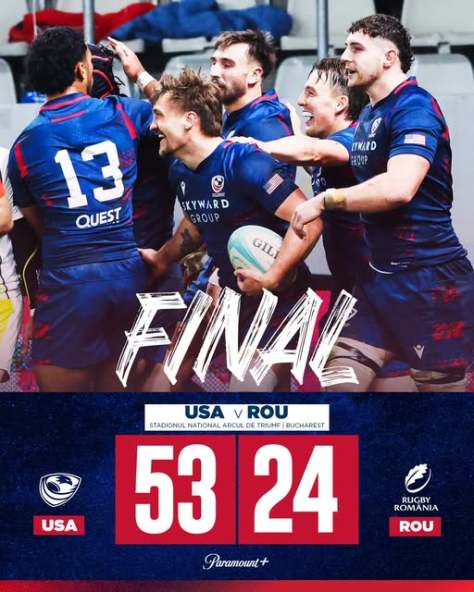
The USA Men’s Eagles have plenty to celebrate. Five consecutive victories, an undefeated Nations Cup campaign, and their pool championship secured with a convincing 53–24 victory over Romania in Bucharest. Seven tries and a 29-point winning margin are encouraging results for Scott Lawrence and his coaching team.

Saturday’s match against Georgia in Tbilisi will be very telling for both teams. Both are undefeated in the Nations Cup, with Georgia ranked 13th in the world and the Eagles 15th. The result will give us a good indication of where our men’s national team stands and whether we’re ready for the next level.

Three Competitive Tiers

The world’s leading rugby nations fall into three reasonably distinct competitive groups.

Competitive tierCountries
Tier 1 — Established powersSouth Africa, New Zealand, Ireland, France, England, Scotland, Australia, Argentina, Wales*
Tier 2 — International challengersFiji, Japan, Italy
On the BubbleGeorgia
Tier 3 — Emerging competitorsPortugal, USA, Spain, Tonga, Chile, Samoa, Uruguay

Wales nearly warranted a separate tier between the established powers and international challengers after its recent decline. But Saturday’s 35–28 victory over New Zealand demonstrated that it still belongs among the established powers.

I’ve been watching Nations Championship and Nations Cup matches simultaneously on separate screens this November. The difference in speed, physicality and intensity is striking. Saturday’s England–Japan match illustrated that gap. England scored 13 tries in a 78–15 victory over Japan, despite Japan competing in the higher-level Nations Championship. Japan had an early red card, but the result was still emphatic. Just two months ago, Japan defeated the Eagles 63–14.

Punching Above Your Weight

What distinguishes Fiji, Japan and Italy is their ability to punch above their weight. Consider some of their significant international results:

NationNotable results
FijiEngland 30–22 (2023); Australia 22–15 (2023); Wales 24–19 (2024); Scotland 29–14 (2025)
JapanWales 24–19 (2025); Italy 27–10 (2026); Fiji 20–15 (2026); USA 63–14 (2026)
ItalyWales 24–21 (2024); Australia 26–19 (2025); Scotland 18–15 (2026); England 23–18 (2026); France 13–13 (2024)*
GeorgiaItaly 28–19 (2022); Wales 13–12 (2022); Japan 25–23 (2024); USA 43–30 (2025)

Italy’s 13–13 draw with France in the 2024 Six Nations is included as a notable result rather than a victory.

Clearly, at present, we have no realistic chance of competing with South Africa, New Zealand or any of the Tier 1 nations. But we must aspire to compete consistently with Fiji, Japan and Italy.

Georgia: The Next Step

Several years ago, Georgia would have belonged alongside Fiji, Japan and Italy in that second tier. Recent results have been mixed, raising questions about whether Georgia has maintained that standard.

Georgia defeated Japan 25–23 in 2024 and narrowly lost to Italy 20–17. Last year it beat the Eagles 43–30 but lost to Japan 25–23. This March, Georgia lost to Portugal 19–17, but has since won five consecutive Nations Cup matches, including Saturday’s 55–31 victory over Tonga.

The Eagles have beaten Georgia before, but their most recent victory was in 2013. Georgia’s record makes it an excellent measuring stick for the Eagles.

What Should We Expect from Our Eagles?

We should expect the Eagles to beat teams ranked well below us and to do so convincingly. We should beat teams like Hong Kong China comfortably, and victories over teams like Romania should be expected every time we play them. Saturday’s 53–24 victory over 23rd-ranked Romania was the kind of performance we should expect.

Our earlier results need context. The Eagles were missing numerous players through injuries and international availability when they lost 61–12 and 52–0 to Australia XV in October. Several overseas-based internationals returned for the narrow 28–26 victory over Hong Kong China, with more available against Romania.

We’ve also had some meaningful victories. The Eagles defeated Samoa 29–13 in September 2025 to secure qualification for the 2027 World Cup. But Japan’s 63–14 victory over the USA in this year’s Pacific Nations Cup semifinal demonstrates the gap between our current level and the nations we’re aspiring to join.

The Eagles made considerable progress during the 2010s, highlighted by their historic 30–29 victory over Scotland in 2018. Eight years later, I find it frustrating that we’re still competing in the middle of this lower tier. We followed that historic win with defeats to Scotland of 42–7 in 2024 and 85–0 in 2025. Eking out a two-point victory over Hong Kong China last week only reinforces that frustration.

We should be further along. Identifying young talent and providing a development pathway with increasingly higher levels of competition is essential to preparing players for international rugby. How we accomplish that deserves a separate discussion.

Our expectations must be higher than simply beating lower-ranked opponents. We need to convincingly beat those around us and increasingly challenge the nations above us. Scott Lawrence’s Moonshot 2031 goal of reaching the Rugby World Cup quarterfinals on American soil will require exactly that.

Looking Ahead to the 2027 World Cup

Our 2027 Rugby World Cup pool includes France, Japan and Samoa. France presents an enormous challenge, while Japan represents the competitive level we’re trying to reach. Samoa is strengthening its squad with former All Blacks Akira Ioane, Josh Ioane and Shaun Stevenson, along with former Wallaby Scott Sio.

We beat Samoa last year, but its strengthening squad makes the next encounter particularly interesting. Holding Japan close and beating Samoa would give us an excellent opportunity to advance to the knockout rounds in Australia.

A Chance to Make a Statement

Georgia is a very good rugby team, playing at home, with a recent victory over the Eagles. It’s going to be tough to beat them in Tbilisi.

A victory would be a significant statement. A competitive performance, even in defeat, could demonstrate progress against a team that beat us by 13 points last year.

The Eagles deserve credit for their undefeated Nations Cup campaign, but our expectations must extend beyond winning matches against lower-ranked opposition.

We must become consistently competitive with Georgia, Fiji, Japan and Italy. That’s the next level for American rugby, and Saturday’s match will give us a good indication of how close we are.


American Rugby’s Competitiveness Problem Reply

As part of my research for The Good, The Bad & American Rugby, I came across an excellent podcast made this week featuring former 34-cap Eagle Juan Grobler, who scored the USA’s only try against eventual champions Australia at RWC1999. Juan joins Springbok great Naas Botha and Ryan Grobler for a discussion about international rugby and why the United States struggles to compete at a high level, like the recently concluded series v Australia A. Interesting to see this issue being discussed on Drop In, one of South Africa’s prominent rugby podcasts.

The central point is one any follower of American rugby should recognize: American players don’t get enough consistent exposure to high-level competition.

I experienced this firsthand. Two weeks before earning my first cap against Australia at RWC1987, I was playing club rugby for Old Puget Sound Beach, with a handful of spectators on the sideline. Two weeks later, I was facing the Wallabies on my debut at Ballymore. The gulf in the levels of competition and speed of play, was staggering.

Nearly 40 years later, we confront the same problem.

Major League Rugby (MLR) has provided professional opportunities for American players, but the standard of competition simply isn’t consistently high enough to prepare them for Tier 1 international rugby. Watching some of our better MLR players struggle against Australia A this weekend reinforced that point.

This isn’t the players’ fault. Rugby players cannot perform consistently at a level they rarely experience. The pace, physicality, decision-making, and execution of basic skills required internationally are developed through regular competition against quality opposition. There is no substitute.

Money is a huge part of the problem (and a big thank-you to all MLR owners who continue to invest, despite severe obstacles to profitability). MLR operates with limited financial resources compared with established professional leagues overseas. This affects the quality and depth of squads, coaching, and ultimately the standard of competition. USA Rugby faces similar financial limitations in assembling and preparing national teams to compete internationally. This gap in resources only grows with each passing year, as ‘the rich get richer’.

See Italy’s participation in the URC, Argentina’s Jaguares previous involvement in Super Rugby, and Japan’s increasingly competitive League One. These competitions provide regular exposure to a very high standard of rugby and directly contribute to national-team development.

The podcast also raises the lack of a meaningful Under 21 competition structure in the USA which is prevalent overseas. Outside the collegiate system, the pathway from high school into senior rugby remains limited. College teams bar very few get consistent high level competition. The scorelines of games played by the top teams often are at a minimum 50 point deficit. I see Army West Point Mens Rugby (my Alma mater) scores regularly in the 70-5 range and cringe knowing this does not improve the standard. It’s fun to post a huge score line on social media, but there is no benefit to the quality of play. This lacuna does little to develop top players, ready to compete at a high level at a relatively young age.

Watching the Eagles in recent weeks, we’ve heard all about “developing players” from Coach Lawrence , but selecting young players isn’t the same as developing them. It’s not Scott’s fault either. He can only work with what he is given.

The immediate future looks difficult.

At RWC2027, the Eagles face France, Japan, and Samoa in what is shaping up to be an extremely difficult pool. Japan continues to benefit from its strong professional competition and players coming through the New Zealand rugby system. Samoa is strengthening its squad with former All Blacks, including Shaun Stevenson, Akira Ioane, and Josh Ioane. This will be a Samoa team not seen in decades.

For the Eagles, any victory in that pool would be a huge accomplishment.

For RWC2031 on American soil, we still have five years to address these shortcomings. But any plans and implemented systems mean little unless they improve the standard of rugby our players experience on a consistent basis.

This is exactly the kind of issue I’ll be exploring in The Good, The Bad & American Rugby: the circumstances that have shaped the competitiveness of our national teams, not simply their wins and losses.

We need our best players playing better rugby, more often. Until we find a way to make that happen, the gap isn’t going to close.

Well worth a listen.

🎧 Drop-In Podcast — Episode 35, featuring Juan Grobler, Naas Botha and Ryan Grobler

Why I’m Writing The Good, The Bad & American Rugby. Reply

My ‘Why’

As we begin building “The Good, the Bad & American Rugby”, I want to share the purpose behind this project.

Like so many rugby players — whether club, representative, or national team — I’ve stood at gatherings where stories flow as freely as the drinks. It might be a match, a wedding, or, sadly, a funeral. Every time, laughter and tears mingle as teammates recall the moments that shaped them. And inevitably, someone says, “We need to document these stories. They have to live on.”

I’ve felt that same pull for years. The shared experiences of American rugby — its triumphs, heartbreaks, and humor — deserve to be preserved. Yet there is no comprehensive record of our national teams, Men’s or Women’s, XVs or 7s. No formal documentation exists.

This book, The Good, The Bad & American Rugby, is my attempt to fill that void. It will capture the stories behind the matches, the personalities who shaped the game, and the culture that binds us. It will include reference materials, images, and historical documents that trace our journey from the gin‑infused watermelon at the founding of the USARFU in 1975 to the upcoming 2031 and 2033 World Cups on American soil.

In addition to the stories and tales, the book will explore the off‑field circumstances that ultimately affect the performance of our national teams on the field — the unseen forces that shape outcomes and opportunities. These include influences such as the Golden Eagles’ funding and its impact on the national 7s program, the role of Title IX as a catalyst for the women’s game, the loss of elite college football athletes in the 1970s, and the 2020 bankruptcy of USA Rugby. Each of these moments tells a deeper story about how culture, policy, and economics intersect with sport.

I want this work to stand as a legacy — a record of where we’ve been and how we got here. I hope it introduces new readers to the sport and reminds longtime players why rugby matters. The good and the bad, the laughter and the tears — all of it deserves to be remembered.

That is my why.

Book Review: Flashpoint — Rugby and America’s Anti-Apartheid Movement Reply

Derek Catsam’s Flashpoint: How a Little-Known Sporting Event Fueled America’s Anti-Apartheid Movement is essential reading for anyone interested in American rugby history or apartheid-era South Africa.

Centered on the controversial 1981 Springbok tour of the United States—and the explosive New Zealand tour that preceded it—the book shows how a rugby tour became a confrontation over much more than sport.

Catsam sets out the political backdrop clearly: Cold War tensions, the growing isolation of South African sport, and the protests, arrests, and famous flour-bomb incident in New Zealand. Australia’s refusal to allow the Springboks to travel through its territory helped route them through the United States, creating an opportunity for American fixtures.

The United States of America Rugby Football Union was still a young organization, having been founded in 1975. A central figure in the story is former Eagle and Eastern Rugby Union president Tom Selfridge, who helped organize the American tour despite mounting opposition from activists and elected officials. The legal battle over whether the matches could proceed brought questions of free expression and public safety into the middle of American rugby.

The New York matches are among the strangest episodes in our rugby history. The Springboks played the Eastern All Stars in Albany before facing the United States in a separate Test at a polo ground in Glenville. That Test was played under extraordinary secrecy, a day earlier than scheduled, before roughly thirty spectators.

One detail Catsam does not include—which Wendy Clark, Tom Selfridge’s daughter, shared with me—is that the Springboks dressed in the basement of the Selfridge home before being shuttled to the field. Personal recollections like this add another dimension to the documentary record.

Readers familiar with American rugby will recognize Skip Niebauer, Lin Walton, Gary Lambert, Denis Shanagher, Tommy Smith, and others from this era. Their experiences are part of the history I am exploring in The Good, The Bad & American Rugby, my book project documenting American national teams through the voices of the people who lived it.

Catsam also briefly discusses the 1988 Pacific Coast Grizzlies tour of South Africa. I was selected for that tour but could not join because I was serving as a U.S. Army captain.

As a 27-year-old rugby player, I would have gone without hesitation, without fully understanding the reality of apartheid. Looking back, I regret not knowing then what I should have known as a responsible human being.

Catsam also considers the position of those who wanted to play rugby at the highest level and believed sport should remain separate from politics. The book makes clear how difficult that position was to sustain when playing against South Africa carried consequences far beyond the field.

The book is extensively researched and well supported. I noticed a few minor factual errors, including a reference to USARFU founder Bob Watkins as “Ed,” but these do not diminish its overall value.

Flashpoint is an important contribution to American rugby history. For those of us researching, remembering, or reassessing this period, it deserves a place on the reading list.

More about Flashpoint and where to purchase it.