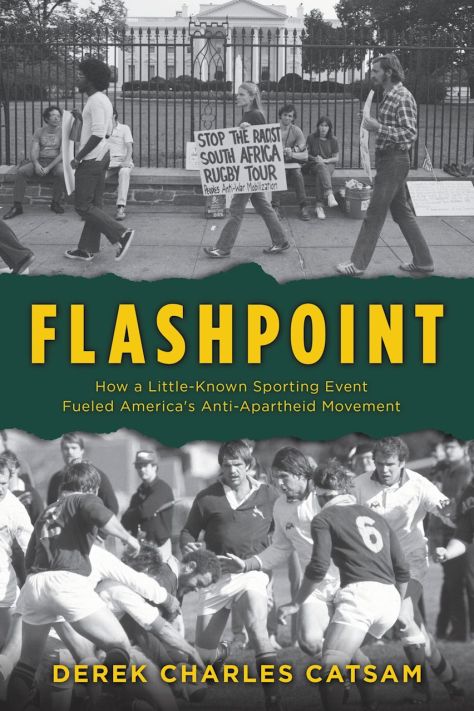
Derek Catsam’s Flashpoint: How a Little-Known Sporting Event Fueled America’s Anti-Apartheid Movement is essential reading for anyone interested in American rugby history or apartheid-era South Africa.
Centered on the controversial 1981 Springbok tour of the United States—and the explosive New Zealand tour that preceded it—the book shows how a rugby tour became a confrontation over much more than sport.
Catsam sets out the political backdrop clearly: Cold War tensions, the growing isolation of South African sport, and the protests, arrests, and famous flour-bomb incident in New Zealand. Australia’s refusal to allow the Springboks to travel through its territory helped route them through the United States, creating an opportunity for American fixtures.
The United States of America Rugby Football Union was still a young organization, having been founded in 1975. A central figure in the story is former Eagle and Eastern Rugby Union president Tom Selfridge, who helped organize the American tour despite mounting opposition from activists and elected officials. The legal battle over whether the matches could proceed brought questions of free expression and public safety into the middle of American rugby.
The New York matches are among the strangest episodes in our rugby history. The Springboks played the Eastern All Stars in Albany before facing the United States in a separate Test at a polo ground in Glenville. That Test was played under extraordinary secrecy, a day earlier than scheduled, before roughly thirty spectators.
One detail Catsam does not include—which Wendy Clark, Tom Selfridge’s daughter, shared with me—is that the Springboks dressed in the basement of the Selfridge home before being shuttled to the field. Personal recollections like this add another dimension to the documentary record.
Readers familiar with American rugby will recognize Skip Niebauer, Lin Walton, Gary Lambert, Denis Shanagher, Tommy Smith, and others from this era. Their experiences are part of the history I am exploring in The Good, The Bad & American Rugby, my book project documenting American national teams through the voices of the people who lived it.
Catsam also briefly discusses the 1988 Pacific Coast Grizzlies tour of South Africa. I was selected for that tour but could not join because I was serving as a U.S. Army captain.
As a 27-year-old rugby player, I would have gone without hesitation, without fully understanding the reality of apartheid. Looking back, I regret not knowing then what I should have known as a responsible human being.
Catsam also considers the position of those who wanted to play rugby at the highest level and believed sport should remain separate from politics. The book makes clear how difficult that position was to sustain when playing against South Africa carried consequences far beyond the field.
The book is extensively researched and well supported. I noticed a few minor factual errors, including a reference to USARFU founder Bob Watkins as “Ed,” but these do not diminish its overall value.
Flashpoint is an important contribution to American rugby history. For those of us researching, remembering, or reassessing this period, it deserves a place on the reading list.

