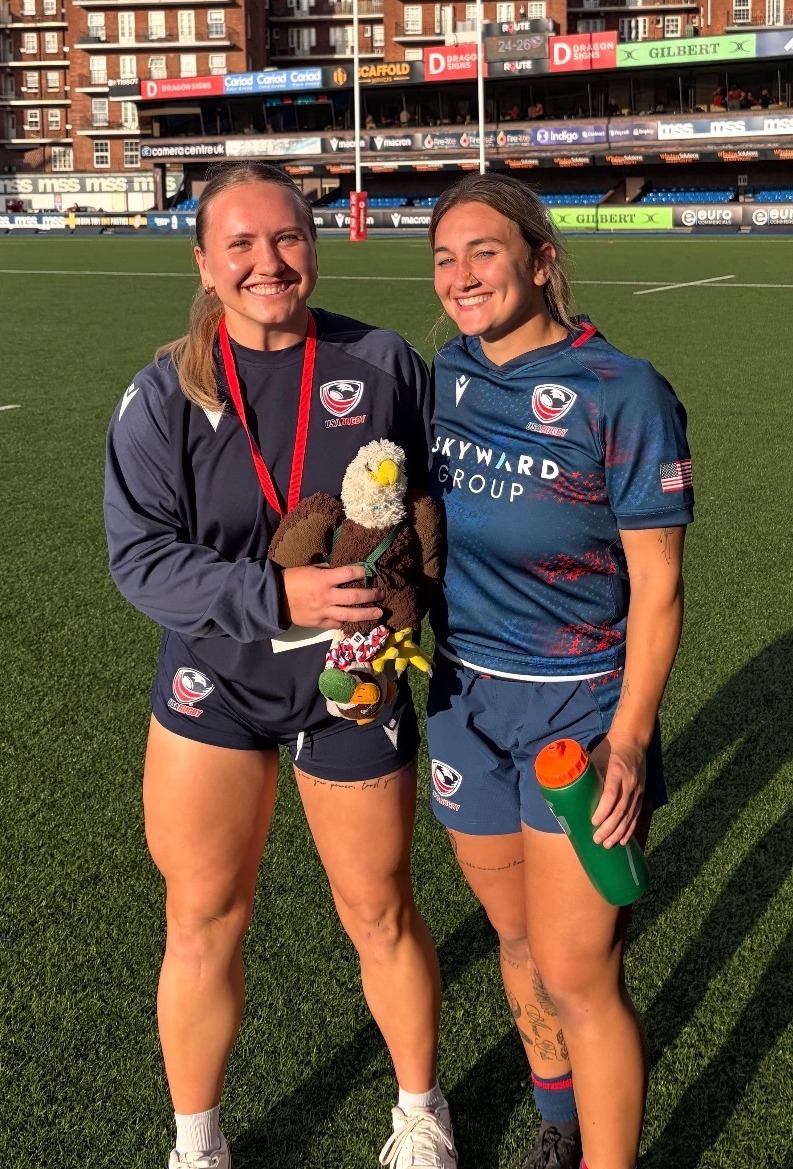
As a rookie on her first tour with the USA Women’s Eagles, Nina Mason had a few responsibilities beyond learning the game plan and preparing for international opposition. One of them was looking after Freddy the Eagle, a stuffed eagle who’s been traveling with the women’s national team for about seven years.
I recently interviewed Nina for The Good, The Bad & American Rugby, my project documenting the history of our national teams. Most of my interviews so far have been with players from earlier generations, so I was looking forward to talking with one of our newest Eagles. I thoroughly enjoyed her. She’s funny, enthusiastic, candid, and seems almost surprised at how quickly her rugby career has taken off.
Back to Freddy. The rookies are responsible for him throughout the tour. Training, meals, the gym, days off—he goes everywhere. The senior players are allowed to steal him, and the rookies are held accountable when he goes missing. Apparently, Freddy disappeared quite regularly during Nina’s first tour, the recent seven-week autumn WXV Global Series that finished against England at Sports Illustrated Stadium in New Jersey.
The rookies produced a Day in the Life of Freddy video, featuring his coffee breaks, lifting, recovery sessions, and other activities. The team also has two “sheriffs,” senior players who keep track of minor offenses and occasionally present their findings in PowerPoint presentations at team meetings.
Anyone who’s been on a rugby tour will be familiar with kangaroo courts and rookie shows. The Women’s Eagles are keeping those traditions alive. Nina and the other rookies, along with some new staff members, organized a game show to entertain the team.
“I’m not good at that stuff. I am not creative,” Nina admitted. Her roommate, Kennedy Feasby, handled some of the singing, which Nina readily acknowledges isn’t one of her strengths. Having endured a few rookie shows myself, I know exactly what she’s talking about.
Nina grew up in Pennsylvania, where her father and grandfather both played rugby. She was more interested in soccer, but at 14 her father strongly encouraged her—bordering on forcing her—to give rugby a try. He drove her 45 minutes to Doylestown Rugby, where they discovered they’d arrived at the adult women’s practice rather than the high-school session.
Nina was five feet tall and knew practically nothing about the game, but her father insisted she join in. A week later, she was playing six matches in a sevens tournament for the middle-school and high-school teams. She’s now 23 and has grown another three inches.
Her father was also her first tackling coach. They practiced in the front yard, where he taught her both how to tackle and how to take a tackle. He subsequently spent countless hours helping her with passing, kicking, conditioning, and defense.
Nina eventually set her sights on Atlantis, the American representative sevens program founded by Emil Signes. She made the team as a teenager and liked the experience enough to have her Atlantis player number tattooed in Roman numerals on the back of her arm.
During our interview, I asked what her number was. She couldn’t tell me because she couldn’t see the tattoo! We spent a few moments trying to work it out. I told her I was Atlantis number 95, although judging by the number of characters on Nina’s tattoo, she’s a lot farther down the list.
Nina went on to Life University in Georgia, where she teamed up with Bella Vogel. The two had played against each other for rival Pennsylvania high-school clubs and now form the 10–12 combination for the Eagles. Bella was recently nominated for World Rugby’s Women’s 15s Breakthrough Player of the Year award, a tremendous honor for a player from outside the traditional top-tier nations.
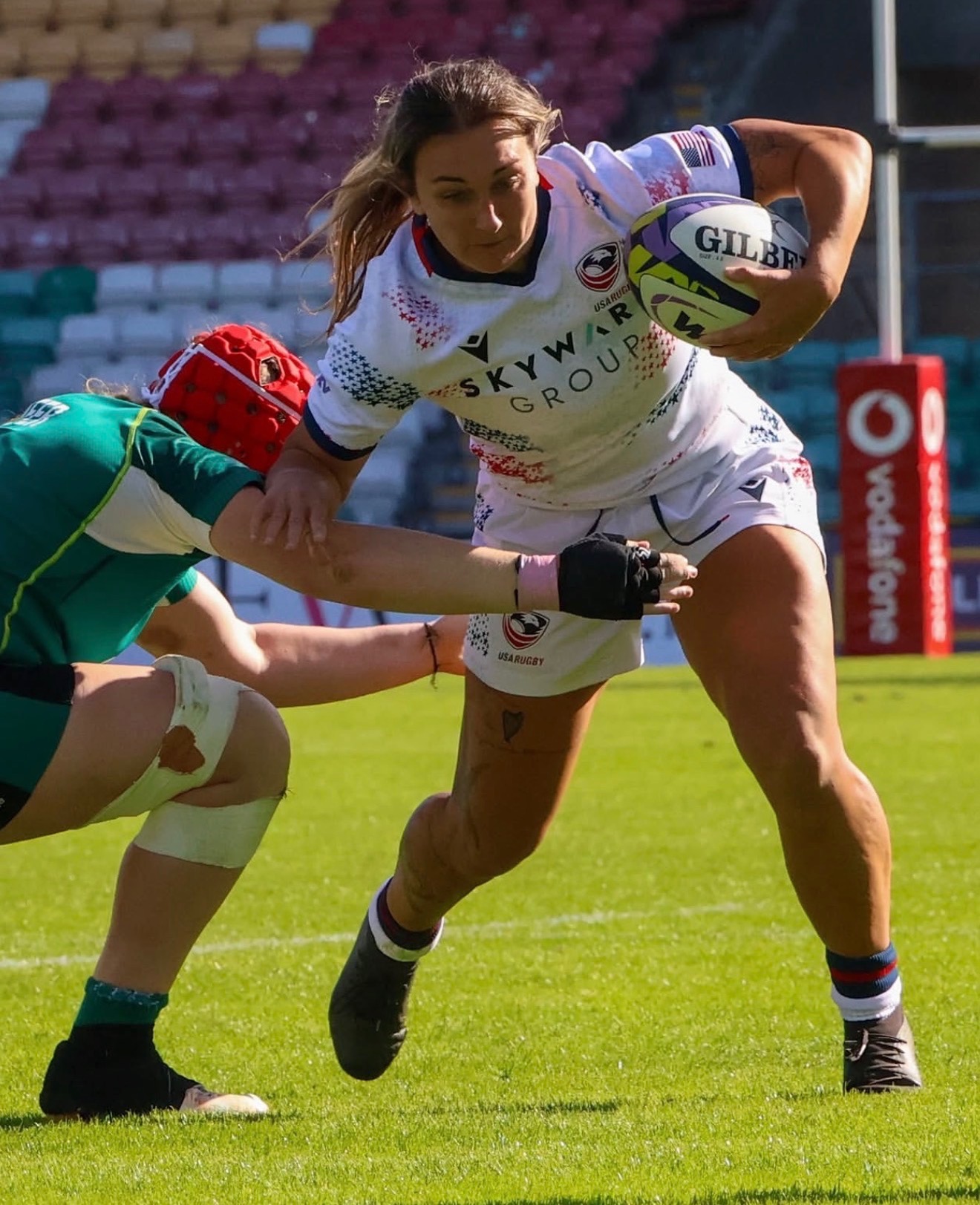
They’re highly competitive with each other. Nina told me that if Bella does another rep in training, she’ll do another one too. “If she’s gonna do an extra rep, I’ll do an extra rep, vice versa.” Apparently, neither is particularly interested in being the first to stop kicking after practice. Both give considerable credit to Life coach Ryszard Chadwick for their development.
An ACL injury during college and a subsequent neck injury interrupted Nina’s progress toward the national team. After recovering, she struggled to get back into the selection picture. Chadwick helped reconnect her with USA Rugby, and in June she attended Jack Hanratty’s playmakers camp in Chula Vista, California.
Three months later, on September 20, she made her Eagles debut against Ireland in Dublin. Her father and grandfather had booked their flights without knowing whether she’d be selected. Nina had studied the game plan, written out different scenarios, and prepared as thoroughly as she could, but told me she almost “blacked out” with excitement when she entered the match.
She remembers seeing her father in the stands. Nine years earlier, he’d practically forced her to attend her first rugby practice. Now he was watching her play for the United States. Proud Dad Moments!
Within weeks, Nina was starting at fly-half and directing players with far more international experience. She admitted that was initially intimidating, but she has clearly earned the confidence of her coaches and teammates.
I am interested in what Jack Hanratty is doing with this Women’s Eagles program. Nina speaks highly of him, particularly the culture he’s building around five team values: accountability, tenacity, excellence, joy, and courage. He also asks players to share their individual “whys”—their reasons for playing rugby. Nina believes those conversations have helped bring the squad together.
I saw some of that camaraderie myself when I attended the England match at Sports Illustrated Stadium and the XV Foundation brunch the following morning. I had the opportunity to talk with several players and came away impressed by their enthusiasm for the team and coaching staff.
The Eagles entered the England match with five consecutive Test victories, their longest winning streak since 2006. During the autumn series, they beat Ireland 40–36, Wales 26–24, and Italy twice, 36–27 and 54–24. England brought that run to an abrupt halt, winning 55–12. The Eagles are improving, but there’s still a considerable gap between them and the leading nations.
Following the series, Hanratty helped Nina secure an opportunity with Harlequins, the storied London rugby club. She’s now preparing to play in England’s Premiership Women’s Rugby competition while completing her master’s degree online.
Nina makes no secret of wanting to win the 2029 Women’s Rugby World Cup in Australia. Hanratty has talked about building toward 2033 in the United States, but Nina isn’t particularly interested in waiting that long. I like her ambition.
I enjoyed getting to know Nina and look forward to following her career with Harlequins and the Eagles. As for Freddy, he’ll be handed over to the next group of Eagles rookies.